Leadership
The Four Ways to Let Go

“When you delegate work to a team member, your job is to clearly frame success and describe the objectives.” —Steven Sinofsky
Maximizing Your Team’s Performance
Delegation is a crucial leadership strategy, especially in fast-paced tech environments. It affects team effectiveness by empowering members to innovate and excel. Leaders may struggle with it, needing to balance guidance and trust, but with a thoughtful approach, it can drive team growth and organizational success.
The Two Trusts: People and Processes
At its core, delegation hinges on trust. Leaders must assess two critical dimensions:
Trust in People: Do your team members have the skills, judgment, and commitment to succeed?
Trust in Processes: Are your workflows, tools, and systems reliable and predictable?
Delegation succeeds when these two dimensions align. A skilled developer can falter in a chaotic workflow, just as a seamless process can’t compensate for a lack of expertise. You can adapt your delegation approach to maximize outcomes by evaluating people and processes.
The Four Delegation Strategies
To navigate varying levels of trust in your team and workflows, you can adopt one of four delegation approaches: Engage, Educate, Engineer, or Empower. Each strategy aligns with a specific trust dynamic and provides actionable steps for effective delegation.
The figure below visualizes these strategies, helping you identify the optimal approach for your current trust levels. Let’s explore each in detail.
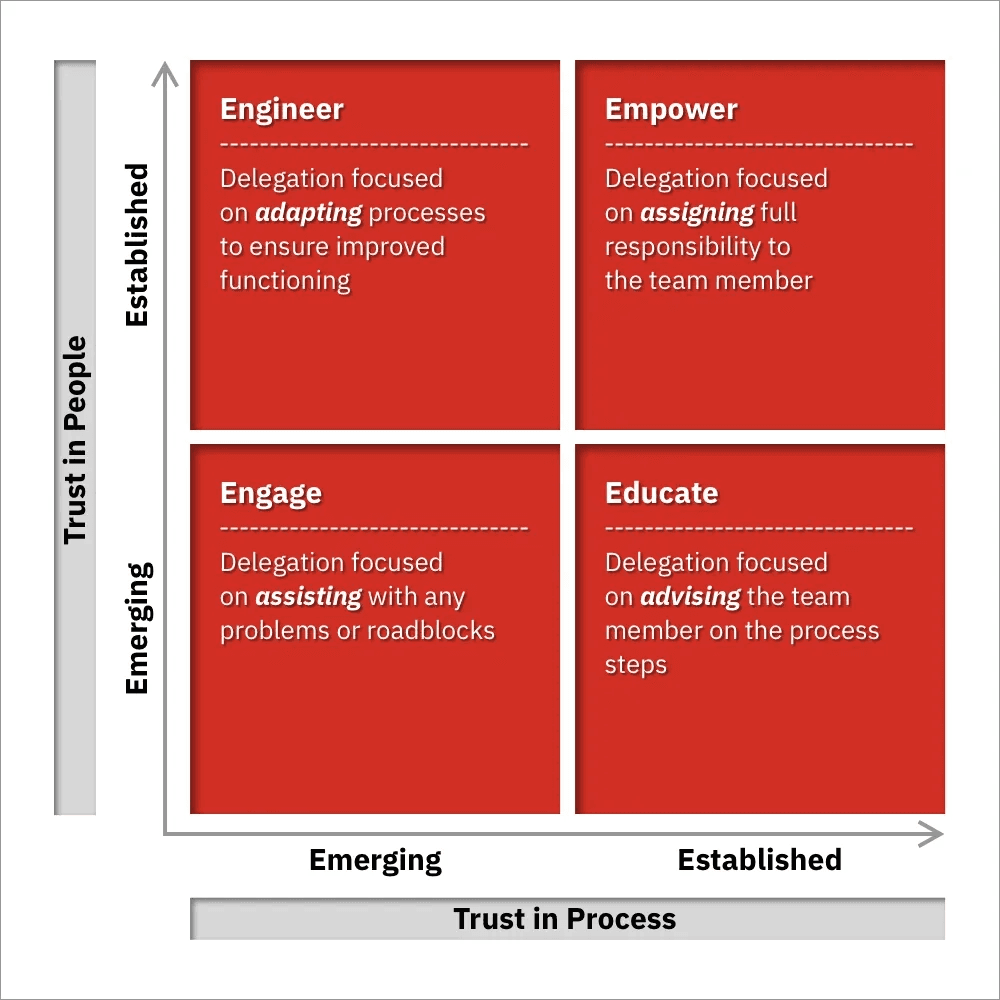
1. Engage: Building Trust from Scratch
When trust in people and processes is low, take a hands-on approach to delegation. This is often the case with new teams or untested systems.
a. Scenario: Imagine you’re leading a newly formed team to implement a DevOps pipeline. The developers are talented but inexperienced with automation tools, and the workflows are still evolving.
b. The Strategy:
Collaborate closely on planning and execution.
Conduct daily stand-ups to identify challenges and resolve them quickly.
Use this phase to build trust in both skills and systems.
c. Outcome: By staying engaged, you provide the support needed to develop confidence and stability. As trust grows, you can step back.
2. Educate: Developing People for Proven Processes
When your processes are rock-solid, but your team is still developing, focus on education.
a. Scenario: You hire a junior developer to work on a robust CI/CD pipeline. While the system is efficient, the new hire needs guidance to navigate its complexity.
b. The Strategy:
Pair them with a mentor for hands-on training.
Provide documentation and break tasks into manageable steps.
Create a feedback loop to ensure continuous improvement.
c. Outcome: Delegation through education builds the individual’s capabilities while maintaining process integrity, preparing them for greater autonomy.
3. Engineer: Fixing Processes for Trusted People
Sometimes, your team is ready, but the processes they rely on must be revised or defined. This is common during periods of rapid growth or innovation.
a. Scenario: Your product team is skilled and motivated, but the roadmap approval process is inefficient, causing delays and frustration.
b. The Strategy:
Collaborate with the team to refine workflows and introduce decision milestones.
Leverage automation tools to reduce manual bottlenecks.
Communicate openly about process gaps and involve the team in designing solutions.
c. Outcome: Stronger processes empower trusted team members to excel, reducing friction and increasing output.
4. Empower: Leading with Confidence
When trust in both people and processes is high, you can delegate with confidence. This is the ideal state of leadership, where your role shifts from managing tasks to driving vision.
a. Scenario: Your lead developer has consistently delivered results, and your Agile processes run smoothly. You trust them to manage sprints and resolve issues independently.
b. The Strategy:
Set high-level goals and step back.
Provide autonomy while ensuring alignment during periodic check-ins.
Recognize and celebrate their achievements.
c. Outcome: Empowered teams take ownership, innovate, and perform at their best—allowing you to focus on strategic priorities.
Common Pitfalls to Avoid
Even with a clear strategy, delegation can falter. Watch for these red flags:
Micromanagement: Over-involvement erodes trust and autonomy.
Unclear Expectations: Ambiguous goals lead to confusion and rework.
Over-Reliance on Individuals: Avoid placing too much burden on top performers—build processes that distribute responsibilities equitably.
The Benefits of Strategic Delegation
Effective delegation transforms teams and organizations:
Increased Velocity: Teams work faster and more efficiently.
Enhanced Innovation: Empowered teams are more likely to take risks and drive breakthroughs.
Scalable Leadership: Leaders gain the bandwidth to focus on strategy, vision, and growth.
Stronger Culture: Delegation builds trust, accountability, and a shared sense of purpose.
Final Insight: Delegation amplifies team potential. You expand your leadership impact by trusting your people and processes, adapting your approach, and empowering your team. Exceptional leaders don’t just assign tasks; they cultivate environments for growth. Are you ready to transform your leadership?