Strategy
Winning Budget Battles as an Engineering Leader

You’re not losing the argument. You’re losing the translation.
If you run platform, infrastructure, or product engineering at any company where uptime or release velocity touches revenue, you’ve probably seen this: sound technical proposals get rejected because the translation misses the mark.
I’ve seen quarters fall apart from bad framing and caused one myself. When that happens, engineering eats the risk while leadership thinks everything’s fine. That’s how quiet misalignment turns into budget battles.
Why Conversations Break Down
Engineers talk in probabilities and root causes. Executives talk in terms of exposure and outcomes.
When engineering says, “decouple this service,” leaders often hear:
“Expensive. Slow. Optional.”
At that point, the whole conversation collapses into cost. And when you’re framed as a cost center, someone starts looking at headcount.
Your job is to make the work legible. Not watered down, just translated into the language leadership already uses.
It helps to know what the room is optimizing for. Executives aren’t weighing your proposal against doing nothing. They’re weighing it against every other use of the same dollar this quarter, most with a revenue number attached and someone arguing for them. An unpriced risk loses that comparison automatically. Not because anyone decided against it, but because it never entered the comparison at all.
When Translation Fails
I’ve lost this argument. Not in theory. With a real system, on a real quarter, in a room where I had all the evidence and none of the language.
We had a service that couldn’t last another year. I presented the failure modes, the coupling, and the on-call load. I explained the architecture carefully, thinking careful meant convincing.
What leadership heard was a rewrite.
“So this is a big refactor with no customer-facing outcome.”
I said no, then explained the architecture again, louder. That was the mistake. I answered a cost question with a design answer.
We didn’t get the funding. Months later, the risk I’d called appeared as an outage on a critical day, in front of people who hadn’t been in that room. Nobody said I told you so. That was worse. It meant the organization accepted the failure as fact rather than the consequence of a decision it had made.
Here’s what I understood too late. Leadership wasn’t dismissing the risk. They couldn’t see it. I gave them a system diagram when they needed an exposure number and a date. The timing and translation never connected.
The part that still bothers me isn’t the outage. It’s that I made the failure look optional. When you present risk as an engineering concern, you quietly tell the room it’s yours to carry, and they let you. The trade-off was made that day. I wasn’t the one who made it, and nobody in that meeting knew they had.
Timing Matters More Than You Think
The same proposal lands differently depending on the month. Planning season favors bigger bets. Mid-quarter firefighting favors the fastest stable path. A pitch shut down in May might be approved in October because leadership thinks about next year’s leverage, not this week’s fires.
Watch for your company’s budgeting rhythm: annual planning, mid-year refreshes, or quarterly re-forecast cycles. Your pitch will land differently depending on which one you enter. When you deliver a proposal matters as much as what you’re proposing.
Nobody told me this early enough: you don’t win budget in the budget meeting. By the time the deck is up, the decision is mostly made. The work happens in the weeks before, one conversation at a time, until the finance partner has seen your exposure number, the product lead agrees the release ceiling is real, and the person who would have objected has already done so privately and been addressed.
If your number surprises anyone in the room, you’ve already lost. A budget meeting should confirm a decision the people in it helped shape.
The Two Currencies of Engineering Decisions
Leadership teams filter every investment through two lenses:
Exposure: what’s at risk if nothing changes
Leverage: how much future revenue or velocity the investment unlocks
Timing decides which one lands harder in the room you’re walking into. So every proposal has to answer three questions, in this order:
What’s exposed?
What’s the business impact if it breaks or slows?
What does it cost us to wait?
The first two set the currencies. The third sets the clock, and it’s the one most proposals leave out. If you can’t answer all three, you’re not ready for the budget conversation.
Here’s how those currencies translate into real decisions.
Sell the Maintenance Tax, Not “Tech Debt”
“Tech debt” sounds like something you can put off.
Try this instead:
“Thirty percent of engineering effort goes to maintenance. One platform investment drops that to 10%. On a mid-sized team, that equals five engineers without hiring, raising your compensation budget, or the three-month ramp time.”
Leaders understand leverage. Give them leverage, not guilt.
Stripe’s report, The Developer Coefficient, shows the same pattern: teams lose massive productivity to maintenance and rework, long before anyone notices the drag. Martin Fowler’s write-up on technical debt explains why that drag creeps up quietly until it becomes everyone’s problem.
Make Reliability About Revenue Protection
Engineers see stability as a virtue. Executives assume it’s already handled.
Reframe it:
“A region outage on a peak day could cost $250K an hour. The range is $200K–$350K based on the last three peak cycles. That’s direct revenue loss before support or recovery work.”
Uncertainty markers make this stronger. Precise but honest beats hand-wavy every time. A tight range plus a line explaining how you got it builds trust without the full spreadsheet.
Make Refactoring About Velocity
“Refactor” sounds like rework. CFOs hate rework.
Better:
“Our identity service caps us at one release a week. Decoupling it gets us daily releases. That unblocks experiments and speeds sales requests.”
Velocity ties directly to revenue. That’s the bridge. DORA’s research shows speed and stability are not a trade-off. Teams that deliver and recover quickly also outperform the rest of the industry.
Credibility Is the Real Slide Deck
The one-slide pitch depends on credibility. If you’ve been predicting fires that never start, your next risk call shows up pre-discounted before you say a word.
Build a track record:
Use ranges
Use confidence levels
Close the loop when something you warned about does, or doesn’t, happen
That third one is the one nobody does. It’s also the one that compounds. The most valuable thing I send after a funded project isn’t the retro. It’s the note six months later comparing what I said would happen with what actually happened.
“In March, I said this would cut maintenance from 30% to 10% and take twelve weeks. It took fourteen. Maintenance is at 13%. Here’s what I got wrong about the migration path.”
Nobody asks for that. Send it anyway. Ranges and confidence levels buy you one meeting. A record of being roughly right and specific about where you were wrong buys you every meeting after. It’s the difference between a leader who persuades and one trusted with an allocation.
When Translation Works
I watched a CTO walk into a budget meeting with a single slide showing:
Annual patching cost
The current release ceiling
The business impact of that ceiling (for them: slower enterprise integrations)
The CFO pushed back:
CFO: “Why not keep patching the old system?”
CTO: “We can. Each patch takes two weeks. We average three critical patches a quarter. That’s 18 weeks a year, half an engineer-year, just to stay still. A 12-week rebuild removes that tax.”
He wasn’t pitching a rewrite. He was pitching time. It got approved on the spot.
Head Off the Cheap Alternatives
Even with a clear pitch, someone will still reach for the “cheaper” workaround. Head those off before they appear. Executives rarely see only two options. They often consider:
“Can we hire one more person to patch faster?”
“Is there a SaaS we can buy?”
“Can we push this to next quarter?”
Each looks cheaper on paper, but none relieve the underlying constraint. Risk and drag remain.
Good proposals answer those before they’re asked, calmly and directly. Show why the “easy” path does not fix the underlying constraint. This shifts you from asking for something to helping leadership avoid traps.
Name the Thing You Killed
There’s a version of this where you get good at winning, and that’s its own problem.
The leader who always secures funding for their own area is the one who has never had to say what they gave up. Executives notice. Once you’re operating above a single team, the credible move isn’t to argue harder for your project. It’s to arbitrate.
So bring the thing you killed.
I’ve done this the expensive way. On a SaaS platform I ran, we paused roadmap expansion for a quarter to pay down architecture instead. That wasn’t a technical decision. It was a decision to trade features people were expecting for a crash-free rate we could actually sell against. I brought both to leadership: what the roadmap pause cost us and what the instability was already costing us. The latter was larger. That’s the whole argument.
“We’re funding the identity work and not the reporting rewrite. Reporting costs us three support tickets a week. Identity caps every release we ship. If reporting starts costing us a deal, I’ll come back.”
That does two things at once. It shows you priced both, and it names the condition that would reverse the call. A leader who names a tradeoff out loud gets trusted with bigger ones. A leader who only brings the thing they want gets managed, not funded.
Make Decisions Unavoidable
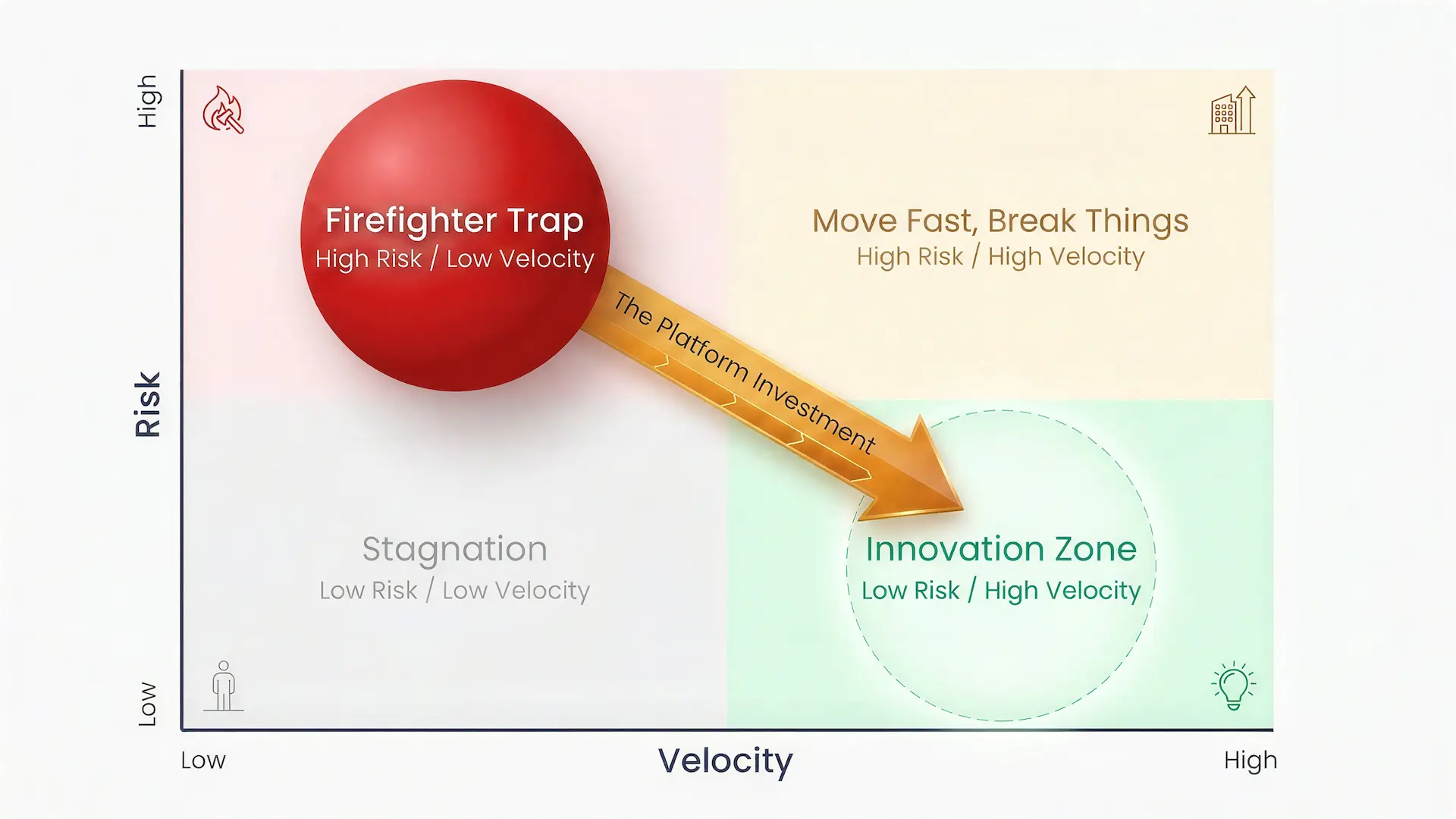
A clean two-by-two often beats a long doc:
High Risk / Low Velocity describes where you are
Low Risk / High Velocity shows where you want to be
One investment is the bridge between them
Circle the quadrant leadership already wants. Make the destination unmistakable, and keep it tight. The moment you add a third axis, you’ve lost everyone.
The point isn’t the picture. It’s that a two-by-two forces you to name where you are, which most proposals avoid. Saying “we’re in the high-risk, low-velocity quadrant and have been for two years” is an admission before an argument. It also makes the ask feel inevitable rather than opportunistic because you establish the starting point instead of asserting the destination.
When the Answer Is Still No
Even when the translation, timing, and track record are right, you’ll still hit “no” when competing priorities or invisible constraints are in play. If the pushback doesn’t map to exposure or leverage, assume there’s a constraint you haven’t seen yet.
The simplest move is a direct question:
“What would need to change for this to be the right investment?”
It surfaces the real blocker without turning it into a fight. Sometimes the answer is a constraint you can solve. Sometimes it’s a commitment you didn’t know existed. Occasionally, it’s that the person deciding doesn’t believe your numbers, which is worth finding out early and directly rather than inferring six months later.
Either way, ask it out loud. Unspoken exposure doesn’t disappear. It just moves on to your team’s on-call rotation, where leadership never sees it and never funds it.
The Shift That Wins Budget Battles
Most rejected proposals aren’t bad ideas. They’re ideas presented in a language the room can’t act on.
Once you translate technical truth into business exposure, impact, and timing, approvals get faster and conversations calmer. But the real shift isn’t tactical. It’s that you stop looking like a line item and start looking like a portfolio of risk-and-growth bets run by someone who knows what each costs and what it’s protecting.
Quick move: Take your biggest technical worry and tie it to one business outcome:
“If X fails, we expose Y. This project cuts that exposure by Z.”
Short, clear, and tied to money.